Machine Learning & AI Maintenance

Maintain on data, not on a calendar.

Most plants still maintain assets on a calendar. Parts are replaced too early, failures still happen too late, and the data the machines already produce is never used. Predictive maintenance changes that by learning failure patterns from real machine and tool data.

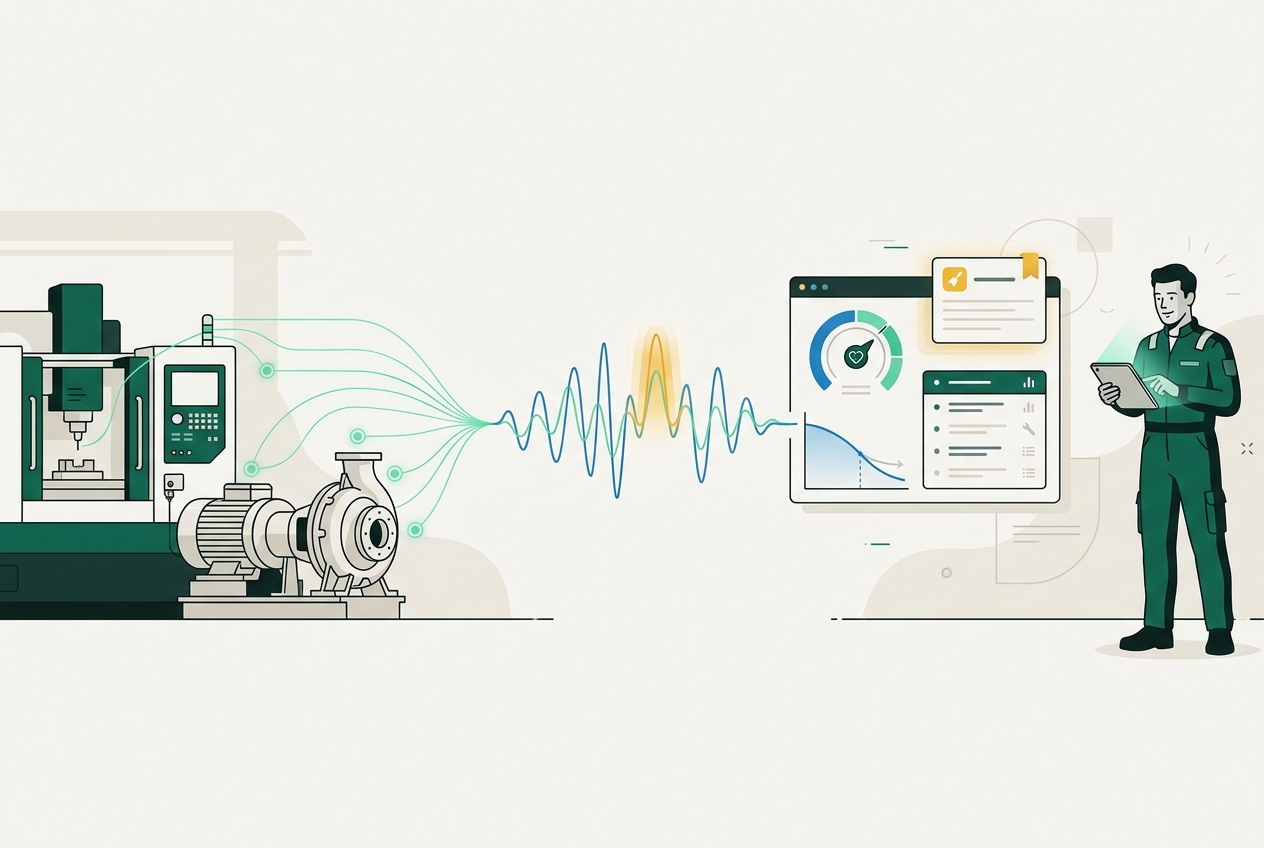
SIHub builds both levels: machine learning models that predict when an asset or tool will fail, and an AI prescriptive layer that recommends what to do about it - which action, which part, which shift, at what cost. Both come with visualization dashboards designed for maintenance teams, not for data scientists.

Machine learning predictive and prescriptive maintenance dashboard for industrial assets

Why calendar-based maintenance quietly costs money

Preventive plans are safe by design, which is exactly why they are expensive: they assume every asset ages at the same rate.

Over-maintenance
Components, tools, and lubricants replaced while significant useful life remains, driving avoidable spare-part spend and material waste.
Unplanned downtime
Failures that develop between scheduled intervals still stop the line, because a fixed plan cannot see a degrading bearing or a worn tool edge.
Unused machine data
Vibration, current, temperature, pressure, cycle counts, and controller signals are already generated, but never collected, contextualized, or modeled.
Decisions without guidance
Even where alarms exist, the technician still has to decide what the alarm means, how urgent it is, and which intervention to choose.

Preventive vs. Predictive vs. Prescriptive maintenance

These three are often used interchangeably. They are not the same, and the operational gap between them is where most of the value sits.

Comparison of preventive, predictive, and prescriptive maintenance strategies
  Preventive Predictive Prescriptive
Core question Is the interval due? When will this asset fail? What is the best action to take, and when?
Trigger Calendar time, run hours, or produced units Model-detected anomaly or predicted remaining useful life Model prediction plus operational, cost, and scheduling context
Data used OEM recommendation and maintenance history Live sensor and machine data, historical failures, work orders All predictive data plus spare-part stock, production plan, cost, and staffing
Technology CMMS plan and checklists Machine learning: anomaly detection, classification, remaining useful life ML predictions combined with AI reasoning and optimization
Output to the technician Service task 4B is due this week. Pump P-102 shows a bearing signature; failure risk is high within 12 days. Replace the bearing on P-102 during the Saturday changeover; the part is in stock at position A-12; deferring past day 9 risks an unplanned line stop.
Main benefit Predictable, low-effort baseline safety Fewer surprises and longer component life Fewer surprises and a decision the team can execute directly
Main limitation Over-maintenance and residual failures Tells you the risk, but not the trade-off Requires reliable predictive models and clean operational context first

In short: preventive maintenance follows a plan, predictive maintenance follows the data, and prescriptive maintenance follows the data and recommends the decision. Prescriptive sits one level above predictive because it does not stop at a warning - it weighs cost, spare parts, production schedule, and risk, then proposes the action. SIHub delivers predictive as the foundation and prescriptive as the layer on top, so each organization can start where its data maturity allows.

It starts with collecting machine and tool data

No model is better than the data behind it. The first step is a reliable, contextualized data foundation from the assets themselves.

Signals we collect

  • Vibration, acoustic emission, and temperature
  • Motor current, torque, power draw, and pressure
  • Spindle load, feed rate, and tool wear indicators
  • Cycle counts, run hours, and machine states
  • Quality and scrap data linked to the same asset

How we get it out of the plant

  • PLC, SCADA, and historian connectivity
  • OPC UA and standard data models for consistent naming
  • Retrofit IIoT sensors where assets are not instrumented
  • Work-order and failure history from the CMMS or ERP
  • Cybersecurity-aware IT/OT integration architecture

The machine learning layer: predicting failure

Models are selected for the asset and the data that actually exists, not for the sake of using a specific algorithm.

Anomaly detection

Learn the normal operating signature of an asset and flag deviations early, including on assets with few or no recorded historical failures.

Remaining useful life (RUL)

Estimate how much life is left in a component or tool under current operating conditions, with a confidence range instead of a single number.

Failure mode classification

Distinguish between failure types - imbalance, misalignment, bearing wear, lubrication loss, tool chipping - so the response can be specific.

Tool wear and tool life prediction

Predict tool degradation from spindle load, vibration, and quality signals to change tools on condition rather than on a fixed count.

Quality-linked degradation

Connect drifting process signals to emerging quality deviations, catching a developing fault before it shows up as scrap.

Model monitoring and retraining

Track model drift, false-alarm rates, and hit rates over time, with a retraining loop fed by confirmed technician feedback.

The AI layer: from prediction to prescription

A prediction is only useful if someone knows what to do with it. The prescriptive layer turns a risk score into a concrete, justified recommendation.

What the AI layer adds

  • Recommended intervention per predicted failure mode
  • Optimal maintenance window against the production plan
  • Spare-part availability and lead-time check before scheduling
  • Cost and risk trade-off between acting now and deferring
  • Plain-language explanation of why the action is recommended

How it reaches the team

  • Draft work orders pushed into the existing CMMS or ERP
  • Prioritized action list per shift and per area
  • Maintenance history and manuals surfaced in context
  • Technician feedback captured to improve the next recommendation
  • Human approval always in the loop before execution

Dashboards built for maintenance employees

The people who fix machines should not need a data platform login and a query language to see what is happening on their line.

Asset health overview
One view of every monitored asset with health score, trend direction, and predicted risk window, sorted by urgency.
Signal drill-down
Vibration, temperature, and load trends over time with anomaly markers, so a technician can see the evidence behind an alert.
Action and work-order tracking
Open recommendations, who owns them, what was executed, and what the outcome was after the intervention.
Performance KPIs
Downtime avoided, MTBF and MTTR trends, prediction accuracy, spare-part consumption, and maintenance cost per asset.
Shift and mobile views
Shopfloor-friendly screens and mobile access so alerts and checklists are usable at the machine, not only at a desk.
Role-based access
Technician, planner, and management views of the same data, each with the level of detail that role actually needs.
How we deliver it

Predictive and prescriptive maintenance is a data and process programme, not a single software purchase. We build it in phases with value at each step.

01

Asset & Data Readiness

Select critical assets, review failure history, assess existing instrumentation and connectivity, and define the target failure modes.

02

Data Collection & Modeling

Connect machines, add retrofit sensors where needed, build the data pipeline, and train and validate the first predictive models.

03

Prescriptive Layer & Dashboards

Add the AI recommendation logic, connect it to spare parts and the production plan, and roll out the dashboards to maintenance teams.

04

Scale, Measure & Retrain

Extend to more assets and sites, track avoided downtime and cost, and retrain models with confirmed field feedback.

What changes in the operation

The goal is not a model. The goal is fewer stops, lower cost, and maintenance decisions that are easier to defend.

Less unplanned downtime
Developing faults are detected early enough to be handled inside a planned window instead of stopping the line.
Lower maintenance cost
Components and tools are changed on condition rather than on a fixed interval, reducing spare-part spend and material waste.
Better planning
Maintenance work is scheduled against the real production plan and real part availability, not against a calendar.
Knowledge retention
Failure patterns and technician decisions are captured in the system rather than living only with a few experienced employees.

Best-fit clients

Most relevant for asset-intensive operations where downtime is expensive and machine data already exists but is unused.

Calendar-based preventive plans High-cost unplanned downtime Existing PLC / SCADA / historian data Rotating equipment and pumps CNC and tool-wear-driven processes CMMS with weak data usage Multi-site asset fleets
Start with the assets that hurt most when they stop. Discuss your maintenance data Request a predictive maintenance PoC